published on 2026-05-01 · by Fábio
Authentic fado or tourist fado — how to tell them apart
Five practical signs to tell whether the fado house you're going to is serious — before you even sit down.
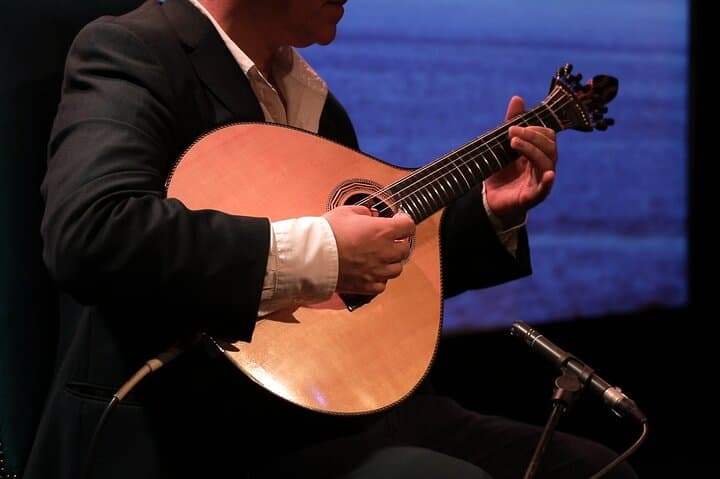
I live in Alfama. From my room, I hear fado almost every night — sometimes good, sometimes not so much. And the distance between a serious house and a tourist trap can be thirty metres and a wrong door.
Most guides tell you "go to Alfama" as if the neighbourhood guaranteed quality. It doesn't. There are extraordinary houses and mediocre houses on the same alley. What sets them apart is not the neighbourhood, not the price, and not the number of stars on Google. It's subtler things — and easier to check than you'd imagine.
Five signs of a serious house
I won't give you a "good" versus "bad" list. Fado is too diverse for moralising. But there are signs that work as a filter, and that you can check before booking or as soon as you walk in.
1. The silence during the singing
This is the most reliable sign I know. In a serious house, when the fadista begins to sing, silence settles in. It isn't asked for — it happens. Glasses are set down, cutlery stops, conversations die. In houses built for volume, the music is background noise: people talk, take flash photos, get up in the middle of a fado. If the silence doesn't exist, neither does the respect for what's happening.
When you visit a house for the first time, watch the first thirty seconds of the first fado. If the room falls quiet, you're in the right place.
2. The fadistas are introduced by name
In a serious house, whoever sings is not anonymous. The owner or the room manager introduces each fadista by name — and often adds a word about their path, their style, what they'll sing. This isn't formality: it's a sign that the house knows its musicians, chose them, and wants you to know who's singing for you.
If the music starts with no introduction, no name, no context — like switching on a playlist — be wary.
3. How many sittings a night
There are houses that do one session a night. There are houses that do two, with different audiences. And there are houses that do three or four, with twenty-minute rotations and a queue at the door. The more sittings, the more factory. A house that pushes three groups a night through the same room has no time to create the atmosphere fado demands.
Ask when you book: how many sessions are there? If the answer is "it depends on the night", it's probably one. If it's "at 7pm, 9pm and 11pm", you're booking a seat on a bus.
4. How you're welcomed
This seems trivial, but it says a lot. In a good house, someone greets you at the door, explains how the night works, suggests where to sit. They don't push you into the most distant corner to free the table sooner. They don't put a menu in your hand before saying good evening.
The welcome is the first sign of what the house values: your presence or your card.
5. It opens on a Monday or Tuesday
This is my favourite filter, and the least obvious. Houses that open on a Monday or Tuesday — the weakest days of the week — do it because they have a loyal audience. They don't depend on the tourist flow of Friday and Saturday. If a house opens on a Monday and the tables are taken, it's because people come back. And they come back because it's worth it.
This doesn't mean a house that only opens Thursday to Saturday is bad. But a house that works on a Monday is almost always good.
What this is not
I'm not saying tourist fado is illegitimate. There are houses that put on a competent, well-produced show with good musicians — and that simply chose a model of high volume and fast rotation. If you have one night in Lisbon and want to hear fado without complicating things, you can have a pleasant night that way.
But if you want to understand what makes fado different — the silence, the tension, the relationship between the one who sings and the one who listens — you need a house where all of that is possible. And for that, the signs above help.
Where to start
If it's your first time, I recommend three different paths depending on what you're after.
If you want to go straight to the music, without giving the whole night, Fado no Chiado is the simplest starting point. About an hour of music in an intimate room in the city centre, no dinner, with silence during the singing. Good for a first time without committing more than that.
If you want a full night — see Lisbon, eat and hear fado in one programme — Fado with tour and dinner does all of that. A tour of the city at the end of the day, dinner with traditional dishes in Alfama, and fado after. More touristy, but honest in what it delivers.
And if you're after something truly different — the view of Lisbon you only get from the river — Fado on a boat on the Tagus is an experience you don't get anywhere else. It's not a traditional house; it's a night on the river, with dinner and fado on board. Worth it for a memorable occasion.
One last thing
The best fado I've ever heard wasn't in a fado house. It was in a neighbourhood tavern, after midnight, with a guitarist who didn't even know he'd be playing that night. That doesn't get recommended in a guide because it can't be reproduced. But if you stay in Lisbon long enough — and if you sit in the right places — it can happen to you. Real fado can't be scheduled. You schedule the chance to meet it.
More guides
Ready to choose a night?
The experiences I recommend, with instant confirmation.
See the recommendationsSee also
The other experiences I recommend.
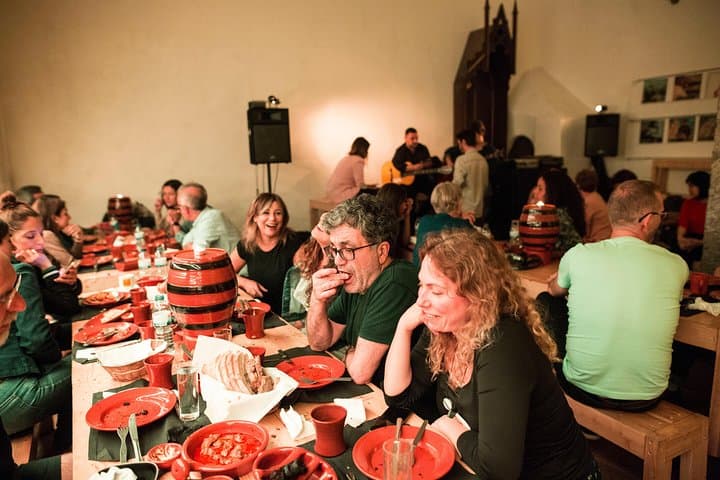
Fado with petiscos — a food tour in three stops
desde€94Three hours, three stops: a deli, a tavern and live fado. Ten petiscos, Portuguese wines and music — the night for those who eat with curiosity.
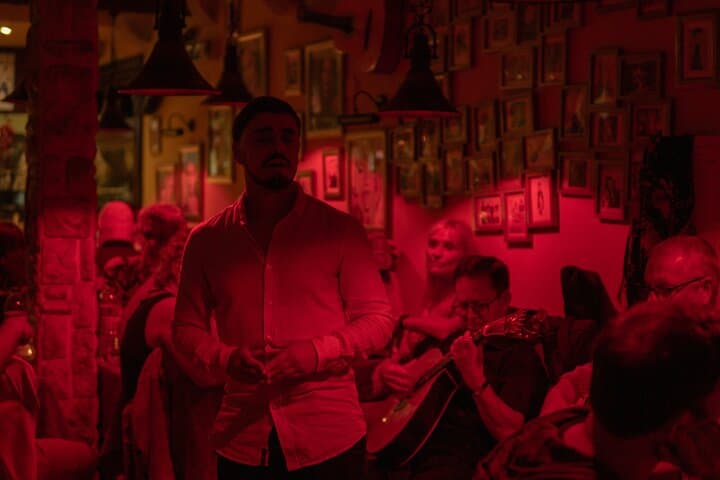
Fado with tour and dinner — a guided night through Mouraria and Alfama
desde€58Four hours: a walk through the streets where fado was born, dinner in a traditional house, and a live show. For those who arrive in Lisbon without context and want to leave with it.
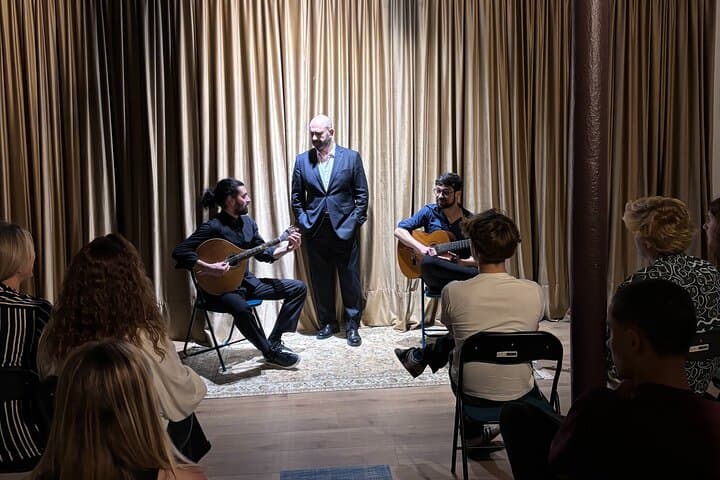
Fado in Alfama — a show in the neighbourhood, with port wine
desde€19An hour of fado in a small room, in the heart of Alfama. No dinner, with a glass of port. The most direct way to hear fado where it was born.