published on 2026-05-01 · by Fábio
Fado with dinner or without — what makes sense for you
With dinner you pay more and stay the whole night. Without, it's freer and cheaper. Neither option is better — it depends on what you're after.

Short answer
Dining in a fado house makes sense when you want a full night with no logistical decisions — a good house charges €50–120 per person with food included. Without dinner, you spend the price of a few drinks — €10–20 — but you lose part of the framing of the night. Dining elsewhere beforehand and going just for the fado is the most flexible option.
One of the first decisions you'll have to make is this: do I book dinner at the fado house, or do I go just to listen? It's not a minor decision — it changes the price, the time, the kind of night, and even your relationship with the music.
I'll be direct: there's no right answer. There are houses where dinner is part of the experience and others where it's an accessory. What matters is that you understand what you're choosing.
The case for dinner
In a good fado house with dinner, the meal isn't just fuel before the show. It's the warm-up. You sit down, order wine, eat unhurried, the room fills, and when the first fadista begins to sing you're already settled in — you haven't just arrived in a rush from another restaurant.
There's a continuity that works. Dinner lowers the pace. You stop being someone who came to "see a show" and become someone who is spending the night there. That difference is subtle, but real.
In Fado with tour and dinner, dinner is a structural part of the night. It begins with a walk through Lisbon at the end of the day, moves to a room in Alfama, and the fado happens after the main course, when you've been at the table for an hour. It's the most complete model I know — you see the city, eat, hear fado, all in one programme.
And if you want the continuity of dinner but with something different — a view, movement, a unique context — Fado on a boat on the Tagus is the floating version of the same format. A sharing menu, fado on board, Lisbon seen from the river at night. It's more touristy than a traditional fado house, and at the same time it's a night that happens nowhere else.
The case against
Let's get to what nobody tells you: in many houses, the food is mediocre. Functional, correct, but mediocre. You pay a high price for a dish that would cost half in another restaurant. Not because you're being cheated — it's that the fado house's business model includes the food as part of the price of the night, and the kitchen is rarely the main focus.
If you're someone who values food a lot and will compare the fado house's salt cod with that of your favourite restaurant, you'll be disappointed. If you accept that food is part of the context and not the protagonist, you'll be fine.
The other factor is time. A night with dinner in a fado house easily lasts three hours. Sometimes more. If you have little time in Lisbon and want to fit fado between other things, dining at the house may not be the best use of the night.
The alternative: fado without dinner
You have two paths to hear fado without committing to a dinner.
The first is a short, structured session like Fado no Chiado — about an hour of music in an intimate room in central Lisbon, no dinner, no three hours at a table. You drink something at the interval if you like. It's the most direct format: you arrive, listen, leave. Good for those with little time or who want to fit fado between other things in the night.
The second is fado vadio in taverns of Bairro Alto and Mouraria — no reservation, no dinner, no guarantees. You arrive, order a drink, and listen to whoever stands up to sing. It's the freest and cheapest format for hearing fado in Lisbon. The risk is quality control: one night it comes out extraordinary, another it comes out uneven. But when it comes out well, there's nothing to compare.
The advantage of going without dinner — on either path — is freedom. You eat where you like, in a good restaurant, and then go to hear music. You separate the two pleasures instead of packaging them together.
When each option makes sense
Dinner at the house makes sense when:
- It's your first time and you want the full experience without complicating logistics.
- You're with someone who values the night as a whole — a couple, an anniversary, an occasion.
- You want to see Lisbon and hear fado in one programme (fado with tour and dinner) or you want the river view (fado on a boat).
- You have the night free and aren't counting the hours.
Going just to listen makes sense when:
- You have little time and want to optimise.
- Food is secondary for you and you'd rather eat well elsewhere.
- You want to spend less — without dinner, the night costs a fraction.
- You prefer an informal format, with no obligation to stay three hours.
A note on wine
Whether you dine or not, you're going to drink wine. Or you should. Not out of obligation, but because fado and wine work together in a way that makes sense when you're there. You don't need to order the most expensive bottle on the list — the house wine, in almost every house I recommend, is honest. Order red, order regional, and don't overthink it.
My advice
If you have two nights in Lisbon and want to use both for fado — which is perfectly reasonable — use one for a full programme with dinner (tour and dinner, or dinner on the boat) and the other for a short session in Chiado, or to look for fado vadio in a tavern. You get both worlds, and you understand which one speaks to you more.
If you only have one night, the decision depends on your profile. If you want to switch off and let the night unfold, go for a programme with dinner. If you want just the music, without committing the night, go to Chiado. If you want adventure and don't mind risking it, go to a fado vadio tavern — but eat beforehand in the neighbourhood.
Book online · Alfama
Dinner and fado at Tasca da Bela
The house's own free tables, right here. Pay a €10 deposit per person and the rest at the house. €60 with dinner, drinks and fado.
Before or after the fado
The rest of your day: Sintra, the Douro, the river at sunset or an afternoon in Lisbon — and how each one fits around a fado night.
Sintra · by day
Sintra by day, fado by night — how to fit both into one day
You can do Sintra and a fado night in Lisbon on the same day, but only with a plan. Train or tour, what to check before booking, and which fado to pick after nine hours of palaces.
See the planDouro · with a night in Porto
The Douro from Lisbon — is it worth it in a day?
In a single day from Lisbon, the Douro is too far. The plan that works: train to Porto, a winery tour from there, and the fado saved for Lisbon.
See the planTagus · at sunset
Sunset on the Tagus and fado — how to fit both into one evening
A sunset sail and a fado night fit into the same day, but the boat's departure time moves with the seasons. When it works, when it doesn't, and which fado to pick afterwards.
See the planLisbon · in the afternoon
An afternoon in Lisbon before fado — three plans that end with fado
A tuk-tuk through Alfama, a pastel de nata class or a food tour through Mouraria: three afternoons that fit well before a fado night, with times and what each one includes.
See the planMore guides
See also
More fado nights I recommend.

Fado no Chiado — 50 minutes in central Lisbon
from€23A short show, no dinner, in the centre of Chiado. 17 years on stage. For those with little time who want to hear fado without heavy production.
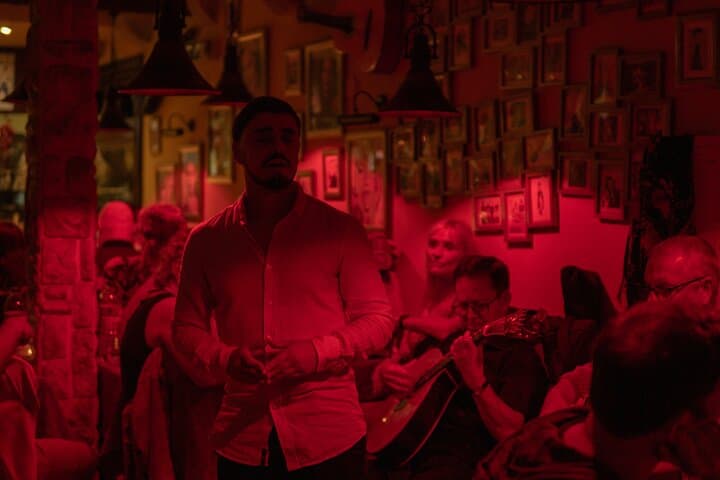
Fado with tour and dinner — a guided night through Mouraria and Alfama
from€55Four hours: a walk through the streets where fado was born, dinner in a traditional house, and a live show. For those who arrive in Lisbon without context and want to leave with it.

Fado on a boat on the Tagus — dinner with a view over Lisbon
from€69Fadistas on board, a shared dinner, Lisbon seen from the river. It's not a traditional fado house — it's a different night, and that's why it's worth it.