published on 2026-05-15 · by Fábio
The Portuguese guitar — the instrument that defines fado
The sound you recognise in three notes. What the Portuguese guitar is, why it's different from a classical guitar, and the role it plays in a fado night.

There's a sound you recognise in three notes that exists in no other music: the Portuguese guitar. If the voice is the soul of fado, the Portuguese guitar is the nervous system. It's worth understanding what you're hearing.
What it is
The Portuguese guitar is a pear-shaped string instrument with twelve metal strings arranged in six pairs. It's played with fingernails or finger picks — small pieces on the fingertips — and the result is a sound that swings between the crystalline and the piercing.
It has two main schools: the Lisbon one and the Coimbra one, with slightly different tunings and timbres. In Lisbon fado — the kind you hear in the city's houses — it's the Lisbon guitar that accompanies.
Why it's not a classical guitar
It's the most common confusion. The Portuguese guitar is not "a Spanish guitar by another name". It's a completely different instrument:
- Strings: twelve metal strings, in six pairs — against six strings (nylon and metal) on a classical.
- Tuning: its own, distinct from the classical guitar.
- Technique: the right hand works in a completely different way, with finger picks.
- Sound: metallic and bright, where the classical is warm and round.
In a fado house, the "viola" — that one being a classical guitar — provides the harmonic base. The Portuguese guitar does the parallel song, the shimmer, the response to the voice.
The role in a fado night
In a fado house, the classic format is the trio: voice, Portuguese guitar and viola. The Portuguese guitar doesn't just accompany — it holds a dialogue with the fadista. It answers between verses, anticipates the next phrase, underlines what the lyrics don't say.
And there are moments when the guitar plays alone — the so-called "instrumentais". That's when you realise the instrument speaks the same language as the voice, just without words. For many people, it's the high point of the night.
Where to hear it well
Any of the experiences I recommend puts the Portuguese guitar front and centre. To hear it up close, in a small room, Fado in Alfama or Fado no Chiado are ideal — you're a few metres from the guitarist. If you also want the context and the history, Fado with tour and dinner explains where all of this comes from. I also have a glossary with the terms.
- Is the Portuguese guitar the same as a classical guitar?
No. It's a different instrument: twelve metal strings in six pairs, a pear shape, its own tuning and a distinct right-hand technique. The classical guitar, in fado, is called the "viola" and provides the base.
- How many strings does the Portuguese guitar have?
Twelve metal strings, arranged in six pairs. It's played with fingernails or with finger picks on the fingertips.
- What's the role of the Portuguese guitar in fado?
It holds a dialogue with the fadista's voice — it answers it, anticipates it and underlines the emotion of the lyrics. There are also moments when it plays alone, the "instrumentais".
More guides
Ready to choose a night?
The experiences I recommend, with instant confirmation.
See the recommendationsSee also
The other experiences I recommend.
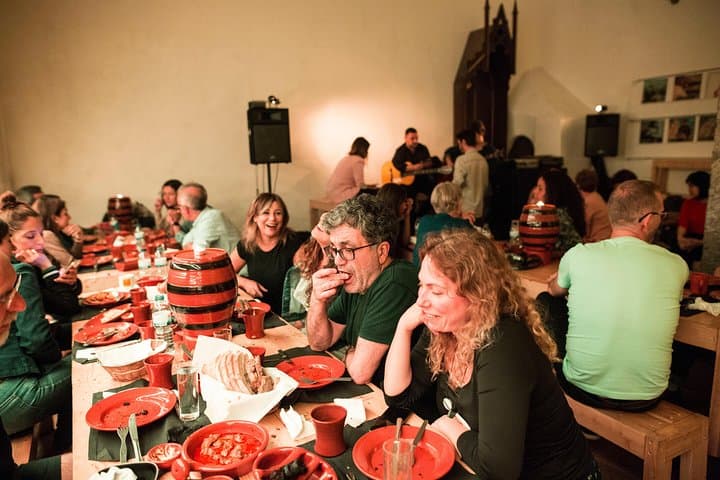
Fado with petiscos — a food tour in three stops
desde€94Three hours, three stops: a deli, a tavern and live fado. Ten petiscos, Portuguese wines and music — the night for those who eat with curiosity.

Fado with tour and dinner — a guided night through Mouraria and Alfama
desde€58Four hours: a walk through the streets where fado was born, dinner in a traditional house, and a live show. For those who arrive in Lisbon without context and want to leave with it.

Fado in Alfama — a show in the neighbourhood, with port wine
desde€19An hour of fado in a small room, in the heart of Alfama. No dinner, with a glass of port. The most direct way to hear fado where it was born.