published on 2026-05-01 · by Fábio
A practical guide to seeing fado in Lisbon — before you go
Everything you need to know before walking into a fado house: when to book, what to wear, how to behave, how to get there.
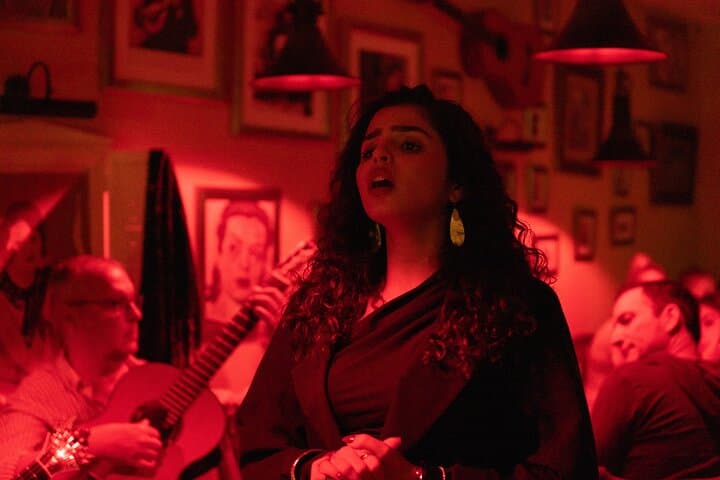
This article is what I wish someone had given me before my first fado night — before I lived in Alfama and all this became familiar. It's the practical things tourism sites don't cover, or cover badly.
When to book
Most fado houses in Lisbon take reservations, and in nearly all of them it's wise to book. Not out of fussiness — because the rooms are small. We're talking twenty, thirty, fifty seats. On a Friday in June, a good house without a reservation is a generous "maybe".
For high season — May to October, peaking in July and August — book at least a week ahead. Two weeks if you want Friday or Saturday. Outside high season, two or three days usually suffice, but there are houses that fill even in January.
The fado vadio taverns in Bairro Alto don't take reservations — they work on a first-come basis. There, the strategy is to arrive early, around 7pm for the evening sessions, and wait.
What to wear
There's no formal dress code in any fado house I know. Nobody will turn you away for wearing trainers. But there's a question of comfort and respect for the place.
In an experience with dinner — Fado with tour and dinner or Fado on a boat on the Tagus — most people dress with care, not in a suit and tie, but considered. A shirt, a simple dress, closed shoes. Not because anyone demands it, but because the context calls for it. In a shorter session like Fado no Chiado, you can go more casual without standing out — but beach sandals, in any case, are out of context.
In a fado vadio tavern in Bairro Alto, wear what you want. Literally.
The most important practical advice isn't about clothes — it's about shoes. Alfama is uneven cobblestones, steep streets, worn stone steps. Pretty but uncomfortable shoes will ruin your night before it begins. Comfort first, aesthetics after.
The rule of silence
This is the most important rule you can learn before going to a fado house, and it's simple: when someone is singing, you don't talk.
It's not a suggestion. It's a rule. In the best houses, the silence during the singing is absolute — and it's what lets fado work. A fadista singing for a silent room creates a tension that disappears with a single whispered conversation in the corner.
In practice: when the fadista begins, put down your glass, put down your fork, stop the conversation. No flash photos. No filming. If you need to talk, wait for the interval between fados — those moments exist, and the room breathes in them.
If you forget, someone from the house will remind you. Don't take it badly — they're protecting everyone's experience.
How much it costs
It depends on the house and the format, but here's an honest guide:
In an experience with dinner included — Fado with tour and dinner or Fado on a boat on the Tagus — expect to spend between €60 and €100 per person, with meal and fado included.
In a music-only session like Fado no Chiado, the ticket is close to €30, with the interval drink on the side.
In a fado vadio tavern without dinner, you spend the price of a few drinks — €10 to €20 per person.
I don't include exact prices because they change. But the difference between the two formats is significant, and it's worth knowing what each implies before booking. I write more about this in the article on fado with or without dinner.
With children, yes or no
It depends on the child and the house. The rule of silence applies to everyone, children included — and if your child can't stay still for forty minutes, the night will be hard for you, for them, and for those around you.
That said, I've seen children of eight or nine completely absorbed by fado. If yours is that type — curious, able to stay quiet, interested in new things — it can work. Talk to the house when you book and ask if it's suitable. Most will be honest with you.
For small children — under five or six — I advise against it. Not out of unkindness, but because a fado session lasts an hour and a half to two hours, in silence, with no visual entertainment. It's a lot to ask.
How to get there
Most fado houses in Lisbon are in Alfama or Bairro Alto — two neighbourhoods of narrow streets where cars don't go, or go badly.
For Alfama: the 28 tram passes through the area, but it's usually packed. A taxi or ride-hail (Uber/Bolt) to the Sé or Largo das Portas do Sol solves it. Then walk — it's five to ten minutes on foot to any house. Be prepared to go up and down.
For Bairro Alto: metro to Baixa-Chiado station, Largo do Chiado exit, and walk up. Or the Glória funicular, if it's running. A taxi to Rua da Misericórdia or Largo do Camões works too.
In both cases, don't plan to park. It's not worth the stress.
When to go
Fado houses in Lisbon generally run Tuesday to Saturday, with some opening on Monday. Fado typically starts around 9pm or 9.30pm — if you have dinner, arrive half an hour to an hour before.
Friday and Saturday are the fullest nights and the hardest to book. If you can, go on a Wednesday or Thursday: the room is calmer, the musicians are the same, and the experience is often better because there's less pressure.
Avoid the month of August if you can. Not because the houses close — most stay open — but because Lisbon is at peak tourist season and everything is fuller, pricier and more impatient.
- How far ahead should I book?
A week in high season (May–October), two or three days in low season. For Fridays and Saturdays in summer, two weeks is safer. The fado vadio taverns in Bairro Alto don't take reservations — arrive early.
- Is there a dress code at fado houses?
Formal, no. But in houses with dinner, most people dress with care — smart casual. The most important thing is to wear comfortable shoes, especially in Alfama (uneven cobblestones and steep streets).
- Can I bring children?
It depends on the age and the child. Over eight, if they can handle silence during the singing, it can work. Under five or six, I advise against it — these are long sessions with no visual stimulation. Ask the house when you book.
- What is the rule of silence?
When the fadista sings, the room stays in total silence. No conversation, no flash photos, no videos. Between fados, you can talk, drink, eat. It's the most important rule in a fado house.
- How do I get to Alfama or Bairro Alto?
A taxi or ride-hail (Uber/Bolt) to the area is the most practical option. For Alfama, ask to be dropped near the Sé or Largo das Portas do Sol. For Bairro Alto, metro to Baixa-Chiado and walk up. Don't try to park.
More guides
Ready to choose a night?
The experiences I recommend, with instant confirmation.
See the recommendationsSee also
The other experiences I recommend.
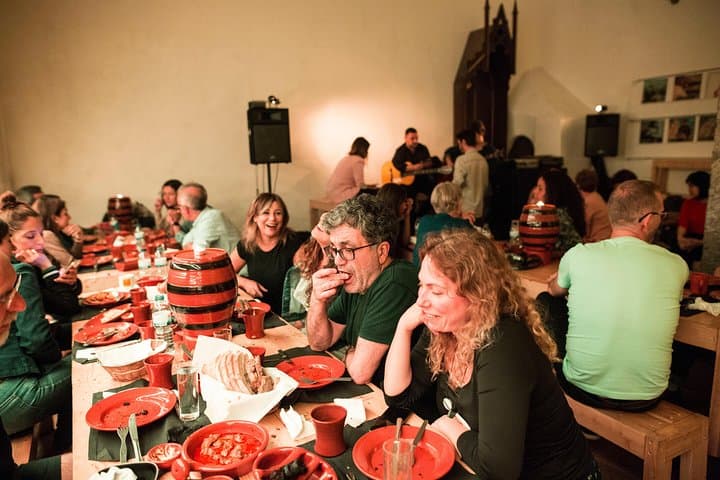
Fado with petiscos — a food tour in three stops
desde€94Three hours, three stops: a deli, a tavern and live fado. Ten petiscos, Portuguese wines and music — the night for those who eat with curiosity.
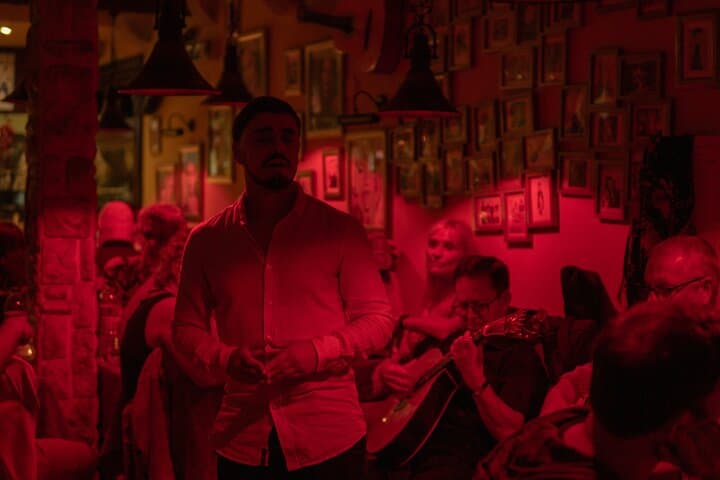
Fado with tour and dinner — a guided night through Mouraria and Alfama
desde€58Four hours: a walk through the streets where fado was born, dinner in a traditional house, and a live show. For those who arrive in Lisbon without context and want to leave with it.
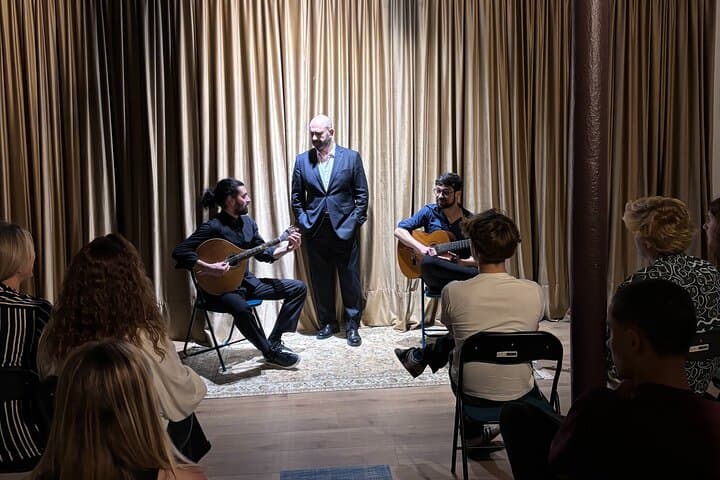
Fado in Alfama — a show in the neighbourhood, with port wine
desde€19An hour of fado in a small room, in the heart of Alfama. No dinner, with a glass of port. The most direct way to hear fado where it was born.